


Specification
Gas Type / Range: Oxygen / 0 - 96%
Sensor Type: OC-40 Ntron Oxygen Sensor
Sensor Life: 3-5 years application dependant
Response Time (T95): <10 seconds @ 20°C
Power Requirements: 24VDC +/- 10%, Max. Load 160mA
Mounting: Optional: Din rail type / Panel type / Wall-mounted type
Display: 100 x 33 dot graphics display module
Display Formats: % Oxygen
Digital Output Opt.: 3 off relay, dry contact 5 Amp rated
Analogue Output: 4 to 20mA, Linearity is +/- 1%
Environmental Rating: Analyser enclosure IP20
Resolution: 0.01% Oxygen
Temperature range: -20°C to +50°C
User Interface: 4 button keypad
Communications: RS 232 bi-directional
Dimensions: 86mm (h) x 69mm (w) x 58mm (d)
Weight: 150g
Electromagnetic Compatibility: CE marked and tested to EN610000-6-4,
EN610000-6-2, EN55022
Applications
An Oxygen Analyser for use in:
• Glove box purge and leak detection
• Additive manufacturing
• Gas generation (Oxygen / Nitrogen)
• Semiconductor wafer machines
• Wave soldering
• Membrane air separators
• Inert welding gases
• Inert ovens
• Medical gas applications
• Pharmaceutical industries
• Food and beverage industries
• Gas generation industries
Microx-211 Ordering Information

Microx-211 Typical Application Setup
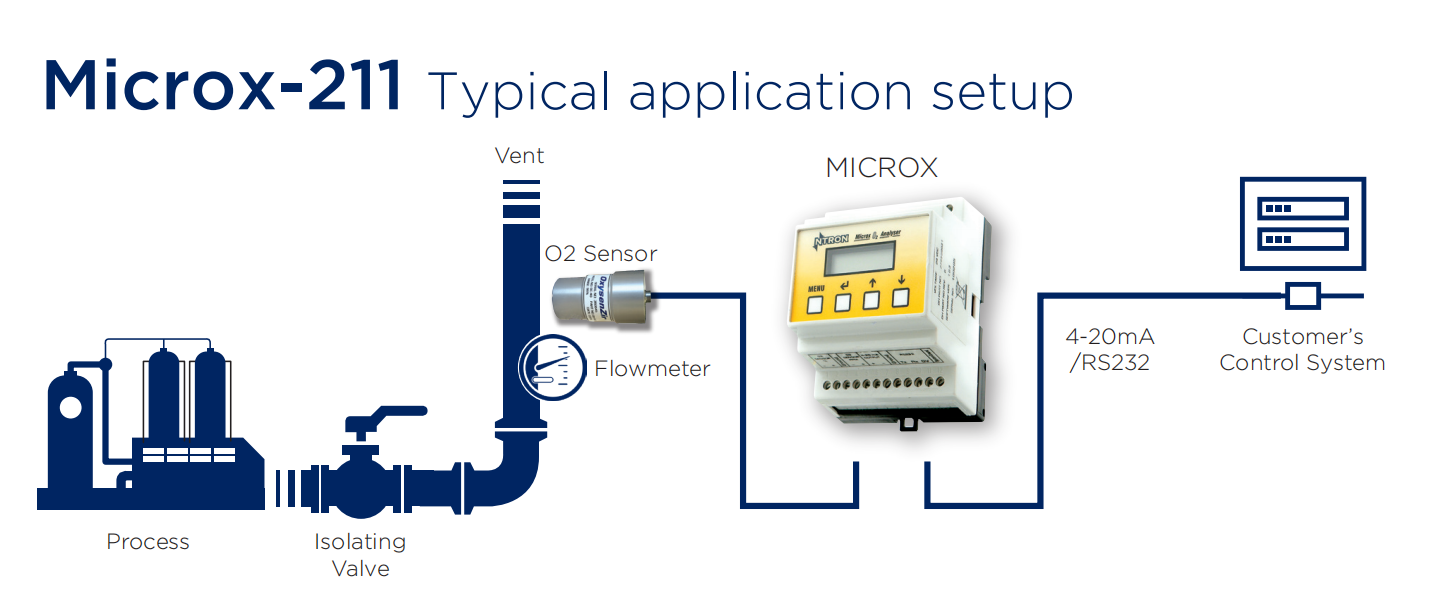
The Microx-211 oxygen analyzer measures oxygen concentration using zirconia sensing technology, with its core based on the principle of oxygen concentration difference cell effect.
Core Working Principle
The core of the zirconia sensor is specially treated zirconia ceramic solid electrolyte. At temperatures above 600°C, zirconia becomes a good oxygen ion conductor. When there is a concentration difference of oxygen on both sides of the zirconia membrane layer (one side is reference air, and the other side is the sample gas to be measured), oxygen ions will migrate from the high concentration side through the zirconia membrane to the low concentration side, thereby forming a stable electromotive force (i.e., Nernst voltage) between the two electrodes. According to the Nernst equation, the magnitude of the electromotive force is directly related to the concentration difference of oxygen on both sides, and by measuring the electromotive force, the oxygen concentration in the sample gas can be calculated.
*This oxygen analyzer can only be used when paired with NTRON sensors.


